
SWISS reports a first-half operating result of CHF 189 million
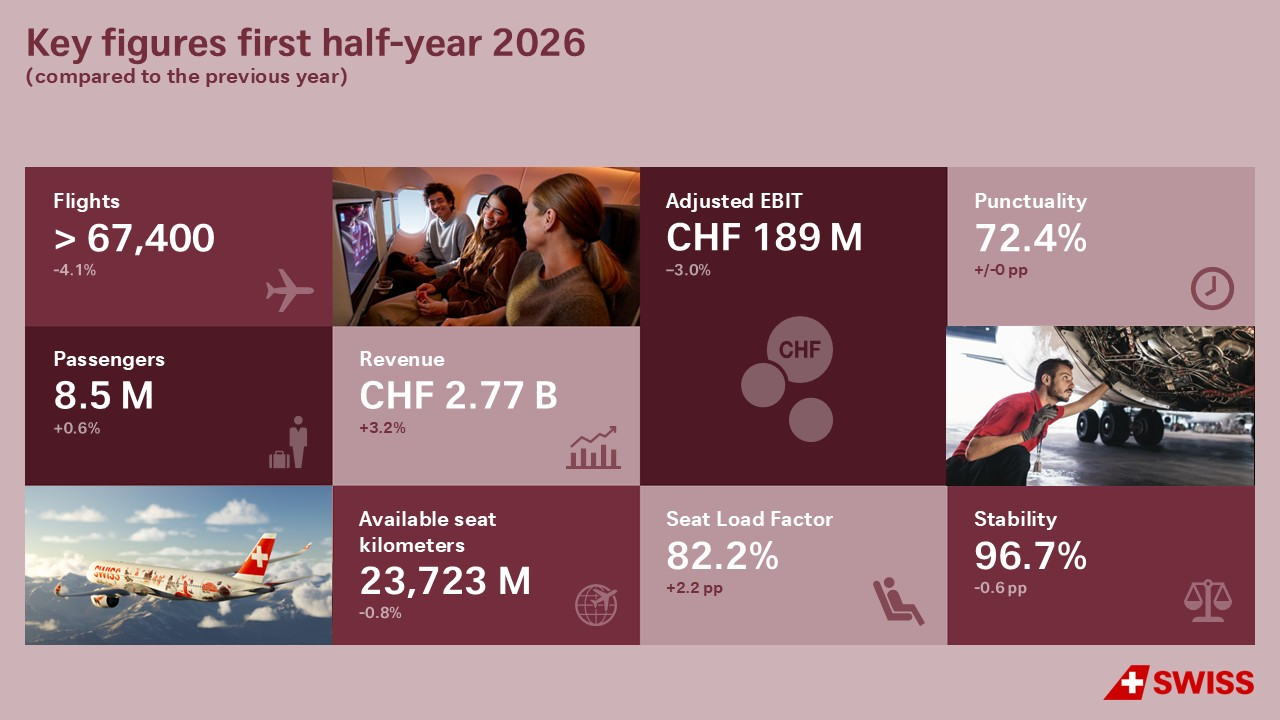
SWISS achieved an operating result or Adjusted EBIT of CHF 189.3 million for the first six months of 2026, a 3.0-percent decline on the prior-year period. Total first-half revenues were raised 3.2 percent to CHF 2.77 billion. Earnings for the period were depressed in particular by the substantial increases in fuel costs since the start of the Iran war. Demand remained strong, especially for premium-class travel. SWISS also took targeted savings and efficiency actions during the period which helped to reduce the earnings decline.
Swiss International Air Lines (SWISS) achieved an operating result or Adjusted EBIT of CHF 189.3 million for the first six months of 2026. The result represents a decline of 3.0 percent on the CHF 195.1 million of the prior-year period. Total first-half revenues amounted to CHF 2.77 billion, up 3.2 percent on the prior-year period (H1 2025: CHF 2.69 billion).
A challenging environment with strong cost pressures
“We met the extraordinary challenges with which we were confronted over the last few months well,” says SWISS CFO Dennis Weber. “But the substantial rises in fuel costs significantly depressed our earnings, despite the hedges we held. Between April and June, fuel costs increased by around 50 percent. Fuel is our single largest cost item. Crucially, however, the savings and efficiency measures that we initiated at an early stage are already having an impact, and are helping us to at least partially mitigate the higher jet fuel prices. If it had not been for these, we would have reported a steeper year-on-year first-half earnings decline.”
“Fuel price trends are beyond our control,” Weber continues. “So it’s all the more vital that we take consistent care of our costs in all those areas in which we are not solely exposed to market developments.”
SWISS’s earnings also continue to be eroded by high maintenance costs, such as those deriving from the already documented problems with the engines on parts of its short-haul aircraft fleet.
On a positive note, earnings continue to be buoyed by still-strong customer demand and higher yields.
“We were pleased to see favorable trends in both our yields and our load factors in the first-half period,” CFO Weber confirms. “Demand for our premium travel classes on our long-haul routes in particular remained encouragingly high, and helped bolster our earnings for the period. But this strong travel demand and our rigorous cost discipline were still not enough to fully offset the adverse effects of the higher fuel prices.”
SWISS also benefited from an unusual situation in certain markets in the first-half period, especially at the start of the second quarter. When some Middle East-based carriers temporarily reduced their capacities, many travelers found themselves seeking alternative travel routings. This in turn generated higher demand for SWISS’s flights, especially to and from Asia. But with the Gulf carriers restoring their production to previous levels, this revenue boost gradually dissipated in the course of the second quarter.
Higher loadings and slight growth in passenger numbers
SWISS transported some 8.5 million passengers in the first six months of 2026, 0.6 percent more than in the same period last year. The company operated over 67,400 flights, 4.1 percent fewer than in the prior-year period. Total first-half production, measured in available seat-kilometers (ASK), was reduced by 0.8 percent, while total traffic volume, measured in revenue passenger-kilometers (RPK), was a 1.9-percent improvement on the first half of 2025. Systemwide seat load factor for the period improved accordingly by 2.2 percentage points.
“Our customers’ desire to travel remains undimmed,” CFO Weber observes. “While we slightly reduced our capacity in the first-half period, we were still able to sell more seats and raise our load factors. Which tells us that many people consciously decide to use SWISS as their airline and put their trust in us and our services.”
SWISS was able to maintain its operational performance at its prior-year levels in the first six months of this year, despite various challenges. Sizeable geopolitical uncertainties and a number of instances of extreme weather conditions impacted on flight operations and first-half performance metrics. Punctuality for the period was unchanged at 72.4 percent, while schedule stability amounted to 96.7 percent, only slightly down from its prior-year level of 97.3 percent.
Costs lowered and resource shortages eased
SWISS is already seeing the first fruits of the cost-saving actions which it initiated some months ago. The encouraging trends in its influenceable costs confirm the prudence of the course adopted and offer good prospects of further cost declines over the rest of the current year. “Initial progress can already be seen,” Dennis Weber confirms. “But a sustainable improvement in our profitability still remains some way ahead.”
Progress has also been made on the fleet management front. While the company had still been expecting at the beginning of 2026 that production for the year would be below that of 2025, it now expects to broadly maintain total annual production at its prior-year level – not least through additional actions in its pilot training and targeted collaborations with its wet-lease partners.
Cost discipline and premium aspirations still centerstage
“As the last few months have proved, SWISS remains a reliable travel partner in testing times, too,” says company CEO Jens Fehlinger. “When the world is a less certain place, people and organizations need to count more than ever on having sound air connections. We help keep Switzerland reliably linked with Europe and the world. And we bear this role and responsibility day after day.”
Looking ahead to the rest of 2026, SWISS expects the actions it has taken to reap further rewards. At the same time, the market environment is likely to remain challenging, with fuel price trends, geopolitical uncertainties and a tendency among customers towards short-notice bookings all further adding to the present high volatility. SWISS continues to treat 2026 as a year of transition, in which it aims to lay the structural foundations for renewed growth and a sustainable improvement in its profitability from 2027.
Fehlinger concludes: “What matters now is that we consistently build on the improvements we have made while continuing to deliver the experience our customers expect from SWISS. We must operate more efficiently, sustainably improve our cost structure, and deploy our resources where they create the greatest value. At the same time, we will continue to invest in our products, our service, and a reliable travel experience. The positive feedback from our customers confirms that we are on the right track. We will continue to pursue this course with consistency. This will lay the foundation for returning to sustainable, profitable growth from 2027 onwards.”
Key first-half figures in brief
| H1 2026 | H1 2025 | Change | |
|---|---|---|---|
| Total revenues (in CHF billion) | 2.77 | 2.69 | + 3.2% |
| Adjusted EBIT (in CHF million) | 189.3 | 195.1 | - 3.0% |
| Passengers carried | around 8.5 million | around 8.5 million | + 0.6% |
| Flights operated | over 67,400 | over 70,000 | - 4.1% |
| Available seat-kilometer (ASK) production | – | – | - 0.8% |
| Revenue passenger-kilometer (RPK) traffic volume | – | – | + 1.9% |
| Systemwide seat load factor | – | – | + 2.2 percentage points |
Key second-quarter figures in brief
| Q2 2026 | Q2 2025 | Change | |
|---|---|---|---|
| Total revenues (in CHF billion) | 1.55 | 1.47 | + 5.6% |
| Adjusted EBIT (in CHF million) | 159.3 | 191.7 | - 16.9% |
| Passengers carried | around 4.9 million | around 4.8 million | + 1.4% |
| Flights operated | over 37,800 | over 38,400 | - 1.7% |
| Available seat-kilometer (ASK) production | – | – | + 1.5% |
| Revenue passenger-kilometer (RPK) traffic volume | – | – | + 2.8% |
| Systemwide seat load factor | – | – | + 1.0 percentage points |